OPINION & ANALYSIS: From Buffet to Barrier: Why the oyster shell upcycling at Bangkok Marriott Marquis Queen's Park is a masterclass in cross-industry synergy
In the high-volume world of Bangkok’s luxury buffets, the success of a venue is often measured by the mountains of seafood consumed. At Goji Kitchen + Bar, the flagship restaurant of Bangkok Marriott Marquis Queen’s Park — the country’s largest hotel by number of keys at 1251 rooms, that success translates to several tonnes of oyster shells every month, sourced from a rotating selection of five to six premium varieties.
But while the diners leave satisfied, the hospitality industry has long struggled with the "afterlife" of such organic waste.
Historically, the hotel diverted these shells to Raitong Organics Farm to be crushed and repurposed as a calcium-rich ingredient in the farm’s chicken feed.
However, the sheer volume of waste eventually overwhelmed even the farm’s capacity, necessitating a more scalable, innovative solution.
The power of specialized leadership
The pivot from agriculture to life-saving technology was spearheaded by the hotel’s current sustainability manager, Pornticha Wongyannava.
Bringing a unique background in the chemicals and paint industry, she recognized that the mineral-rich composition of oyster shells held potential far beyond the farm.
Under her guidance, the hotel launched an industry-first collaboration with Bayer, the National Nanotechnology Center (NANOTEC), and the Bangkok Metropolitan Administration (BMA) that extended beyond repurposing the shells.
Instead, it involves a sophisticated upcycling process where the empthy shells are transformed into calcium hydrogen phosphate. This compound serves as a high-quality fire-retardant material capable of self-extinguishing within a critical 10-second window.
From waste to welfare
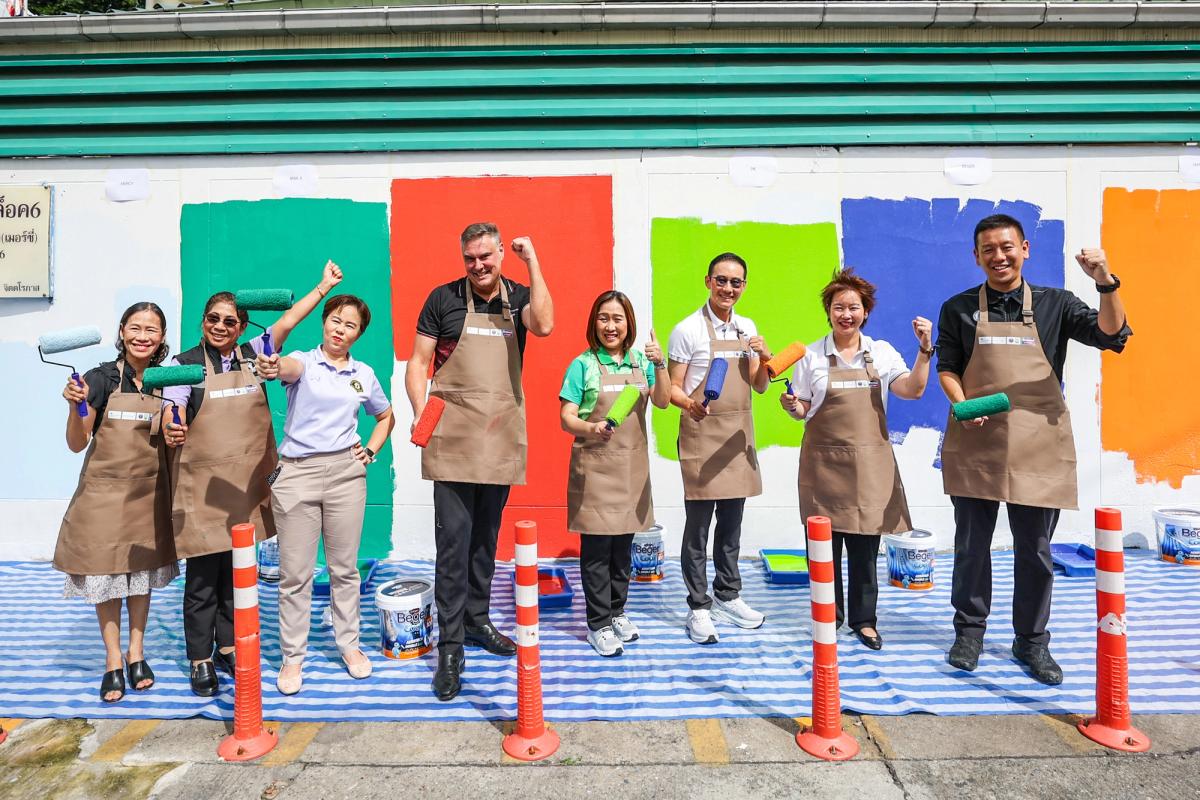
The practical application of this research saw hotel volunteers and community members descend upon the Mercy Early Childhood Development Center in Bangkok’s Khlong Toei district, and other schools in low-income areas of the Bangkok metropolis.
In these vulnerable, high-density neighborhoods, fire is a constant threat.
By refurbishing the school with this innovative, fire-resistant paint, the project provides teachers and students with a vital "leeway" of retardant (around 10 additional seconds) for escape during emergencies.
Analysis: The case for industry crossover
In my opinion, this initiative sets a new benchmark for Marriott International’s Serve360 platform and the hospitality industry when it comes to sustainability measures and collaborations, or recycling and repurposing.
It moves the needle from "doing less harm" to "doing more good" by utilizing specialized technical knowledge from the pharmaceutical and chemical sectors to solve a hospitality waste problem.
For too long, sustainability in hotels has been confined to eliminating plastic straws or reducing laundry cycles.
The Bangkok Marriott Marquis Queen’s Park model suggests that the future of the MICE and hospitality sectors lies in industry crossover.
When we stop looking at waste as a disposal problem and start looking at it as a raw material for other sectors, whether it be construction, safety, or science — we can chance upon solutions that are both environmentally sound and socially impactful.
We need more of this creative synergy. If a discarded oyster shell can protect a child in a fire-prone slum, imagine what other "waste" is currently sitting in our bins waiting for the right collaboration to unlock its value.